I'm increasingly convinced that the early phases of lunar heavy industry will use looney tunes engineering. Somebody posted Landis 2005 on X/Twitter a few weeks ago and I've gripped by it ever since. This post is a plea for help to invalidate the idea and free me of its wiles.
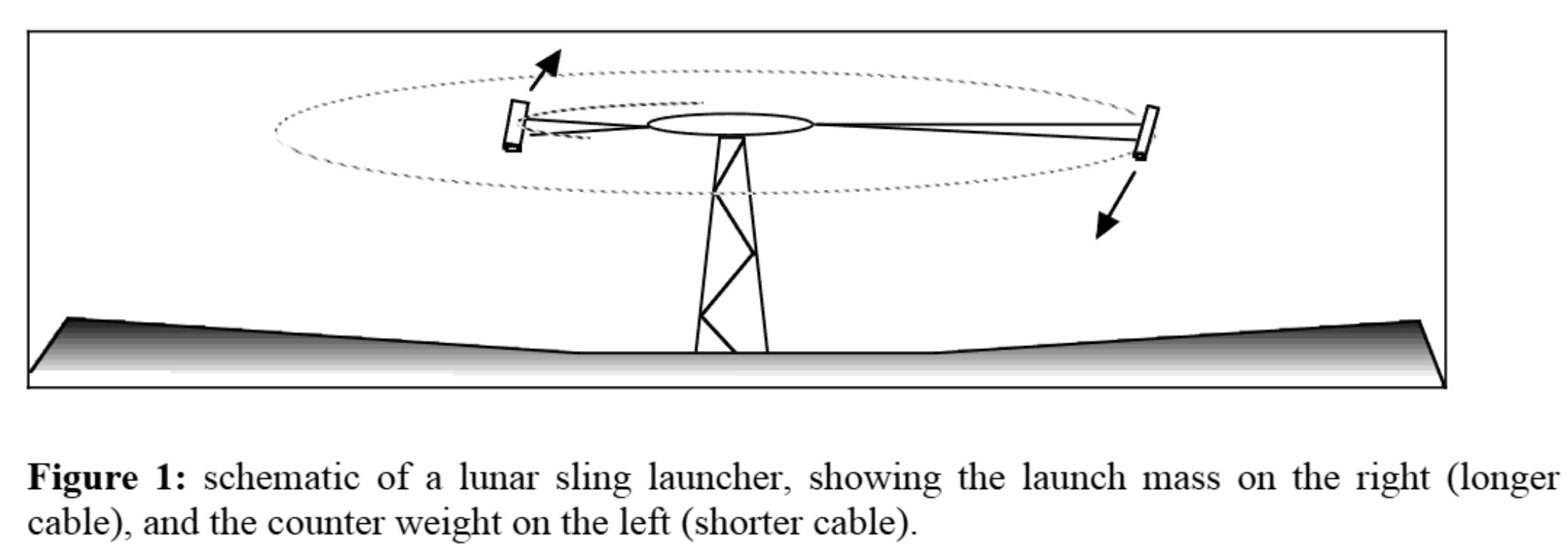
The idea is to build a modestly tall (20 meters would do) tower on the moon and cap it with a big turn-table containing a spool of heavy cable. You hang a sturdy ~2000kg payload from the end of the spool and then spin the turntable up such that centripetal acceleration pulls your payload outward and draws the cable taut. You don't need to spin fast - maybe 23 rpm - so you should be imagining a stately "whoosh.... whoosh... whoosh... " as it swings around once every ~3 seconds -- if there was air to whoosh, which there won't be. Next, you start to pay your cable out off the spool. Your payload sweeps a larger and larger circle every three seconds, so it needs to move faster. That faster movement bleeds momentum from your hub, but you put more power in with a nice efficient electric motor. As you let out more cable you just keep spinning at the same speed and the centrifuge tension keeps your payload at the same height off the ground.1 Eventually you get to 1 km radius at 23 rpm, so your payloads speed is 2pi * 1 km * 23/min = 144.5 km/min == 8671 km/h == 2.4 km/s == lunar escape velocity. Your payload is experiencing 591x Earth gravity trying to fling it outward (hence sturdy), and if you can let go of it at the right millisecond, it will coast on a leisurely 3 to 6 day journey to Lagrange Point 1 in the Earth-Moon system.
Earth-Moon Lagrange points are magical because you can shoot something from the moon or Earth with just the right velocity and approach vector, and when it gets there gravity will have sapped all its speed relative to the Earth-Moon system and it'll just sit there2, waiting to be grabbed and turned into a datacenter or space hotel or autarkic civilization. Visonaries like O'Neill have long dreamed of mining metals and rocket fuel on the moon and flinging them up to L1 (Or L2/L3/L4 for longer term plans) to fuel industry in space to the tune of millions of tons per year, but the classic proposal is a mass driver, IE some sort of electrically powered propellant-less gun. Elon is excited about building one to build space datacenters.
Now to the puzzle driving me to write this post: mass drivers are much harder than their geek culture prominence leads you to believe, and this sling thing sounds comparatively... easy? Of course building anything on the moon is life-consumingly hard - I don't plan to try it soon - but the sling has a lot going for it. And the sling is woefully under-reported. I can't find anything written about it except for Landis 2005 linked above, and a 2008 talk which is not available online. Landis 2005 is brilliant, but it's almost science fiction3 both because reusable rocketry wasn't commercial in 2005, and because Landis was proposing a 50km radius with fullerene nanotubes to be much gentler with the payload. That isn't necessary for flinging refined metal, solar panels, and water ice / LOX slush. You can do low single digit kilometers diameters and use mass manufactured materials like the polymer used in fishing line, and the math works.
The Trade
The trade Elon and O'neill propose is to spend a lot of mass to build a mining, refining, and launch complex on the moon which will deliver orders of magnitude more mass to space on a timeline short enough to make sense. At the extreme end of low time discounting, lunar industry is a clear winner because the moon is rich in useful metals, silicon, hydrogen and oxygen (although regrettably not much carbon) and the moon has far less gravity than Earth, so if you want lots of stuff in cislunar space of course you should go get that stuff from the shallower gravity well. But we live in a time where capital must provide competitive returns, even if you're SpaceX. Even if your objective function is not money but creating an autarkic spacefaring civilization for your own ends, money with a time discount rate applied is an extremely good proxy for all the resource constraints on your mission.
So, the goal crisply stated with a sane deadline: Minimize the cost of gathering a billion tons of useful materials in cislunar space by 2040. Humanity's total scoreboard as of writing is under 50,000 tons across all nations since the beginning of history. SpaceX's first fully reusable (as opposed to first stage reusable, second stage disposable) rocket can lift 100 tons per launch, so the base case here is ten million rocket launches larger than those that carried Apollo to the moon in the next 15 years. Early per-launch costs (to SpaceX, not external customers!) for Starship ought to land somewhere in the $5-50M range, and in the hypothetical where we do ten million such launches they would likely sink closer to the fuel costs at ~$500k, so our base case is perhaps 5 trillion USD, with an NPV of 1-3 trillion depending on what discount rate you give SpaceX. If we accept the $500k Starship launch, that's $5.50 per kg to orbit as the long term price to beat.
In the lunar schemes, we spend a huge chunk of the early capital expenditure launching then lowering (no atmosphere to brake into, sadly) equipment onto the moon with the expectation that it will produce useful mass and capacity to launch that mass to orbit at an exponentially increasing rate which can outrun the exponentials of capital depreciation and decreasing Starship launch costs to justify itself and beat the base case. All that to say, lunar schemes need to pay back fast.
Mass Drivers Need a Big Moon Base
The three popular flavors of mass driver are coil guns, linear synchronous motors, and rail guns. Roesler 2013 is nice medium-deep reading, but Oversimplifying:
- A reluctance coil gun is a series of electromagnets wrapped around a barrel. Each one is powered before the projectile enters it and then depowered before it leaves to yank a magnetic bullet along the barrel without holding it back after it passes. At lunar escape velocity even a 20 meter long electromagnet section will be traversed in 0.0083 seconds. 8.3 ms is an eternity in logic electronics land, but pulling all the energy out of a massive inductor in that timespan is hard. The speed record for actually-existing coilguns I can find online is under 200 m/s, less than 10% of what the moon requires. This isn't to say they're impossible, there are many 'paper gun' architecture papers with km/s speeds, but it's new ground.
- Linear synchronous motors (and some things papers call coilguns which, as far as I can understand, are really LSMs again. Internet autists please appear to educate me if you actually know more than me.) are also electromagnets wrapped around a barrel, but they can shoot merely conductive payloads instead of magnetic ones because the traveling wave of the magnetic field intentionally "outruns" the bullet, creating a moving magnetic field over the bullet which induces current in it, which in turn creates the magnetic field necessary to accelerate it. This is what next-generation US supercarriers use to fling aircraft into the sky, and what powers high speed trains. Both of those examples are below 200 m/s as well. The AI agents whisper of faster LSMs in development projects and such but refuse to give me a citation above 200 m/s, and generally agree nobody has built a meaningfully supersonic LSM on Earth.
- Rail guns are two very sturdy conductive rails you put a conductive bullet across and dump a monster current through. The current screaming down the rails makes gargantuan magnetic fields between them and the same current surging across the bullet creates monster fields of its own. These fields fight each other to produce magnetic pressure behind the bullet and accelerate it to actual, demonstrated speeds of several km/s, more than enough for lunar escape. The gotcha here is that the rails have to actually touch the bullet to deliver the current, or once it gets going they must be touched by a hot plasma generated by all the electromagnetic violence being done, and at exit velocities of 2.4 km/s the rails will wear and require frequent maintenance.
All three approaches share several tough constraints:
- The gun experiences reaction forces and huge magnetic forces within itself, so after delivering thousands of kg of gun mass to the moon you must spend about that much again supporting it.
- That superstructure is a horizontal linear building hundreds of meters in length on the moon. You need large amounts of human or robotic labor to build that, we have no plausible near-future technology to place such a thing on the moon preassembled.
- Shots accelerate from rest to 2.4 km/s in milliseconds to seconds, so you need a large pulsed power system to accumulate all the energy for a shot and dump it in that timeframe.
- The near-instantaneous acceleration means precise launch velocity control is difficult, which will expand the "arrival region" of space around the Lagrange point where you must gather your resources. All reasonable (IMO) proposals for lunar launch involve tiny thruster systems on every shot to steer them at Lagrange and the mass required for that is surprisingly small, but it increases if your exit velocity has big error bars on it.
- Aiming the gun is impossible, or if possible requires very expensive (in mass and cash/complexity) upgrades to the supporting structure. This is bad because your Lagrange target is a roughly fixed point in the lunar sky, but orbital mechanics are complex and the moon has some "wiggles" in its orientation which will change your aim mildly. This is very surmountable, but it's another term in the "how much fuel do I need for steering at apolune?"
- Your bullet has constraints on its shape, conductivity, etc for the gun to work, and in the railgun case it gets incredibly hot so launching volatiles like (probably frozen) water and liquid oxygen is doable-but-complex.
- Separate from all the other bullet constraints, the gun and bullet have a relative velocity of mach 6 (in Earth STP anyway) and you need a bearing system to keep them from destroying each other. This almost certainly means either destructive plasma generated by the rail gun itself, or a hypersonic magnetic levitation system intermingled with all the other extremely violent and powerful magnetics you're trying to do in the same space. If you aren't going the pure play railgun route, your mag-lev system's carriage either must be launched off to Lagrange with every shot, or decelerated for reuse with even more large linear infrastructure.
All of these constraints are surmountable and someday in the future I think it's likely we'll use mass drivers of some sort to build sites that launch thousands of tons per day from enormous mines. The mass driver architecture is much more compact than the sling, IE you can build a lot more launch capacity per km^2 of lunar area, which will eventually be a constraint worth caring about. But, everything above pushes strongly toward "build a big moon base before you do the mass driver." You would strongly prefer to use in-situ materials for the gun's supporting structure, you need a bunch of skilled labor to build it, you need to manufacture fairly complex "bullets" for the gun to shoot, etc. It's not something you can drop onto the surface with a handful of ships.
Lunar Sling 2028
I expect reality to prove this false, but my current understanding is that the sling can turn a single starship landing into a 500 kg/day4 launch system to L1. Let's review the challenges of mass drivers for the sling:
- The sling has no pulsed power requirement. Energy can be titrated into the system at almost arbitrarily low power to slowly spin the system up until launch. Your launch capacity scales smoothly with the continuous power available because you can spin up faster.
- The sling requires a single central tower with a turn table on top, no sprawling superstructure to build. A single upright starship with guy wires and a shotcrete-ish foundation would suffice.
- Launch velocity control is governed by how accurately you can hit 23.000 rpm instead of 22.9 with a system of enormous inertia, and if you're unhappy with your exact velocity you can hold onto the projectile until you are. You get a “check velocity, fire if perfect” window every 3 second rotation
- Aiming across the horizon is trivial for the tether, just change release timing. Inclination costs a lot of complexity if you want it, but you probably don't need it, and if you do the complexity is compact enough for a single landing, not an enormous active structure like the gun aiming platform which must be assembled in-situ.
- No components of the sling system experience high relative velocities in close proximity except the tether tip relative to the lunar surface, many meters below it. Neither high speed magnetic levitation nor highly durable armature rails are necessary. The central hub system is extremely low speed. If not for the lunar environment it would be a trivial application of conventional large rolling element bearings used in cranes. In the dusty, cold-welding-vacuum lunar environment you probably want something more exotic but in the limit you can "just" seal the bearings and use conventional lubrication because again, the linear speeds between hub components are very low - under 10 m/s even if your bearings are a full 8m Starship payload diameter.
- The sling has no large monolithic components to deliver to the lunar surface, nor critical tolerances between large components which must be managed through 100C swings of thermal expansion in the lunar environment.
There's a bevy of engineering challenges to be solved, but they're all firmly engineering, not fundamental science nor magic. Let's explore the most interesting ones.
Tether Mass
The sling needs to bear the centrifuge loads of the payload at the tip, and also its own weight. If you've read about space elevators you know where this is going: this system can't be built with a steel cable because the cable's own weight down at the tip increases how much cable you need above it, which increases how much thickness you need above that, and your cable cross-section blows up exponentially. Fortunately we only want a km or two of length, and the tensions necessary for lunar escape are big but not impossible so the taper ratio of root:tip cross section can be about 7 for advanced-but-not-magic polymers like PBO. However, this still means the tether will vastly outweigh its payload. For 1500kg of tip payload and a safety factor of 2.5 the tether masses about 24,000 kg.
Fascinatingly, that mass is approximately independent of your choice of length for a fixed tip velocity and choice of material. As you increase length the tip tension decreases with 1/L, and the taper ratio stays the same because your sling is spinning slower for the same tip velocity, which means the average cross section of the whole tether dcreases with 1/L and the length of course grows with L so terms cancel and your tether is 24 tons whether it's 1 km or 20 km. So the motivating tradeoff for tether length is not mass, but dynamic stability.
Release Dynamics
The naive sling system described so far has some nasty behavior when you release the payload. With ~600G of centrifuge acceleration, letting go of the projectile is an enormous change in force. Depending on your choice of polymer and how over-specced your tether is, the load will stretch it by tens of meters. At release that stretch wants to snap back, and it turns out the naive system is fairly easy to 'bullwhip' so violently at release that the tip of the tether would break off. With the payload gone the tip of the tether sees the full hundreds-of-meganewtons tension of the tether pulling on a bit of rope with just a few kg of mass, it accelerates very violently radially-inward and then the centrifuge whips it back outward to its death.
There are various schemes you can pursue to mitigate this, but the one I'm currently fond of is to keep a lot of extra mass at the tip of the tether so payload release is a smaller change in load, and there's lots of inertia to resist the whip. That means you're throwing away a lot of the payload capacity of your big, heavy, expensive tether, but I think it's the right trade to make because it also allows for some nice separation of concerns. In the naive story we're deploying the primary tether and winding it back in for every shot, winding down to reload, and going again. 24 tons of tether is being cyclically deployed-and-stowed and needs to be robust to that abuse, the whole platform needs to spin down and back up, and we need to get the system back to perfect stability before release after each redeployment. The naive version isn't totally impossible, because you can spin most of the way down before reeling the tether in which helps a lot, but I think the right answer is to keep it spun up indefinitely and load shots Interstellar style:
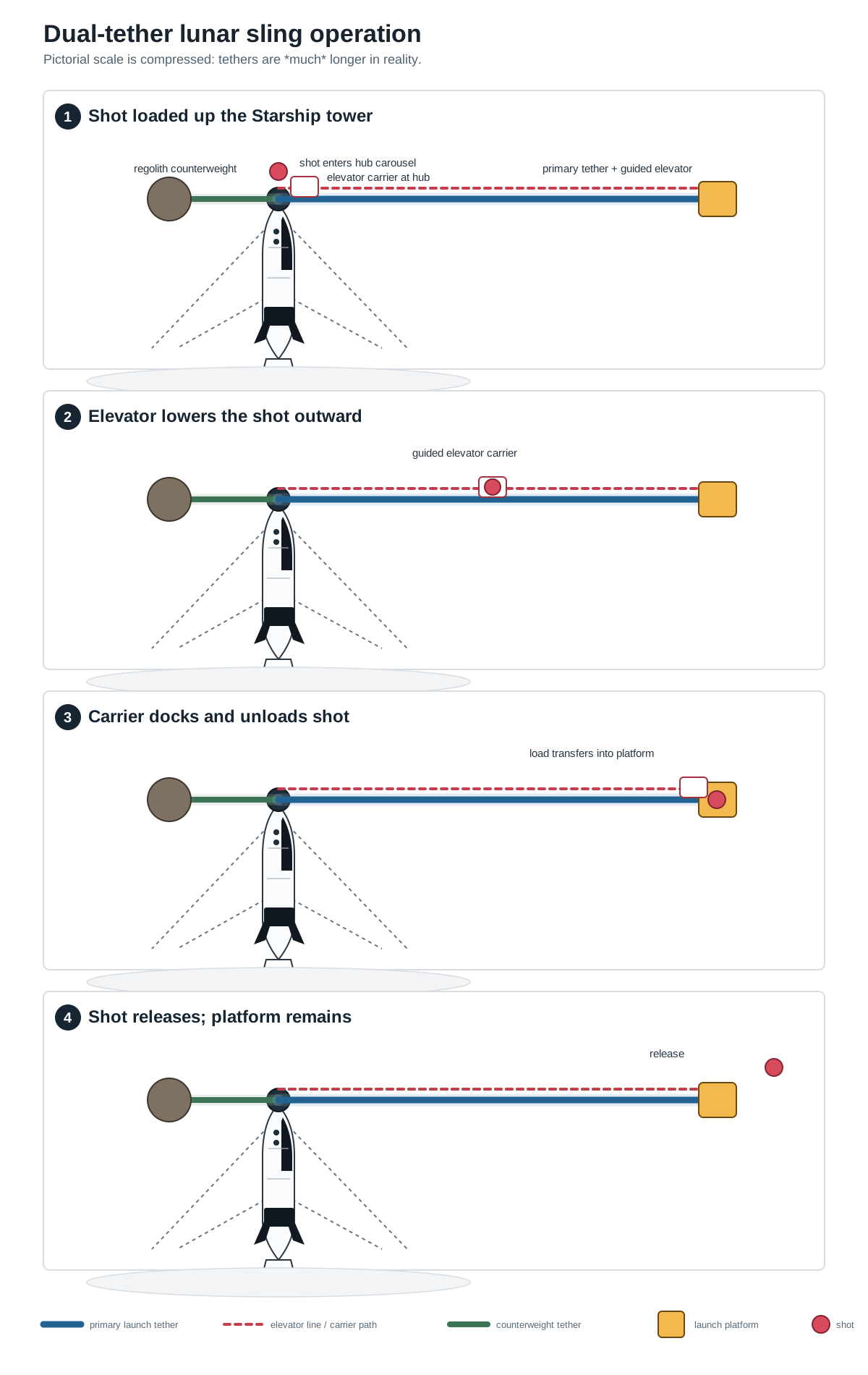
The rotating structure is only doing 23 rpm if we choose an arbitrary 1 km radius, so loading the shots through the central hub isn't actually that spicy. This transforms the system from a big centrifugal slingshot into a sort of ground-based space elevator. The tip is at orbital velocity at all times, but the tether is yanking it back along a non-ballistic circular route. Payloads get lowered "out" to orbit and then released. You still have to pay for the energy: the payload being lowered saps rotational inertia from the main tether which needs restoring at the hub motor, but you only pay for the energy of the actual shot instead of bringing tens of tons of tether along for the ride. Tether mass is still paid for in the bearing drag at the hub, but that should be a very low constant compared to full spin-up-spin-down operations.
It's also worth thinking through whether the 'elevator' wants to be an actual second tether lowering the shots down, or if we should extend the space elevator analogy and use a climber that lowers itself down a series of fixed points on the primary tether. If we want to go that way, it maybe makes sense to do a small partial spindown while reloading to cut the centrifuge forces. The acceleration goes with velocity^2, so you can regeneratively brake 30% of your rotation and drop climber loads in half.
Counterweights
The starship would snap like a twig if you tried to run this system unbalanced, so you need an extra tether deployed out the other end of the hub to keep the system balanced. This tether can be made shorter and thereby less massive, because the math above showed constant mass wrt length while holding tip velocity constant and here we're holding rotational velocity constant. This is probably a big fused lump of regolith. It doesn't see absurd acceleration because it's at a much shorter radius, so it doesn't have to be terribly strong.
When I was initially enamored with the naive version of sling launch, I was imagining these regolith slugs as disposable because a Spinlaunch style system wants to release the payload and counterweight simultaneously to avoid unbalanced loads on the hub bearing. However, I realized that's not a tractable design because the counterweights impacting downrange would sandblast the tether to death. Dust and pebbles on Earth almost immediately decelerate to their terminal velocities in air, on the moon there's no such braking force so if you punch the surface with a fast projectile it will shoot back with bits of debris at a similar speed.